R&D Offsite 2025: Building What’s Next, Together
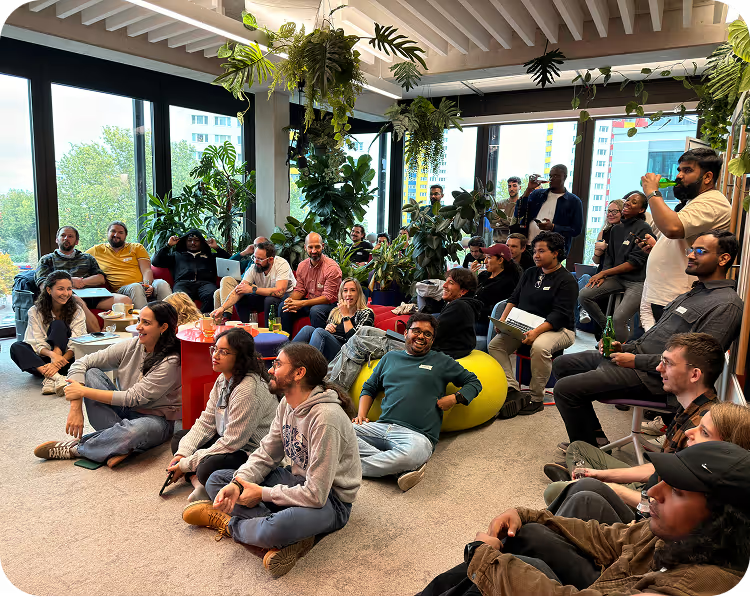
What happens when great minds meet with a shared purpose?
Earlier this year, our Product, Data, Learning Experience, and Tech teams came together in Berlin for our first-ever R&D Offsite; three energizing days of connection, collaboration, and creativity.
Together, we explored how to keep shaping the future of coaching; from strengthening our core product and scaling growth through AIMY™, to reimagining how we work across new cross-functional Tribes and a Platform Excellence Task Force.
We learned, experimented, and set our “Big Bets” for what’s next guided by a shared vision: one roadmap, one team.
Beyond the strategy sessions and hackathons, what stood out most was the spirit of collaboration, the energy that comes from people connecting in person to build something that matters.
Because when we invest in connection, we strengthen everything that follows: innovation, impact, and the future of coaching.
🎥 Watch the highlights from our R&D Offsite 2025 here.
FAQ
Digital transformation is about redesigning how organizations operate, compete and create value in a rapidly evolving environment.
However, AI only delivers transformative impact when it is integrated into workflows, leadership practices and cultural norms. Without behavioral change and organizational redesign, AI remains a powerful tool with limited strategic impact.
When embedded effectively, AI strengthens innovation and increases agility, making it both a catalyst and a core capability within digital transformation.
Assessing AI readiness goes beyond evaluating technical infrastructure. It requires examining leadership alignment and organizational capability for change.
Businesses should consider:
- Do leaders share a clear and consistent vision for AI?
- Are workflows and roles being redesigned to integrate AI effectively?
- Do managers have the skills to guide their teams through uncertainty?
- Are employees confident in using AI responsibly and strategically?
- Is there a structured plan to support behavioral change over time?
AI readiness is as much about mindset and capability as it is about technology, since organizations that are prepared to invest in leadership development, change agility and performance measurement are significantly better positioned to translate AI ambition into sustained results.
The biggest challenges of AI adoption are rarely technical. They are behavioral and organizational. Common barriers include cultural resistance, fear of being replaced, lack of clarity around expectations and insufficient leadership alignment.
Many organizations underestimate the need for sustained reinforcement. A one time rollout or training program is rarely enough. Without ongoing support, accountability and reflection, initial enthusiasm fades and adoption plateaus.


.png)